 enCAST.pro
What Camera and Gear Should I Buy for My Budget?
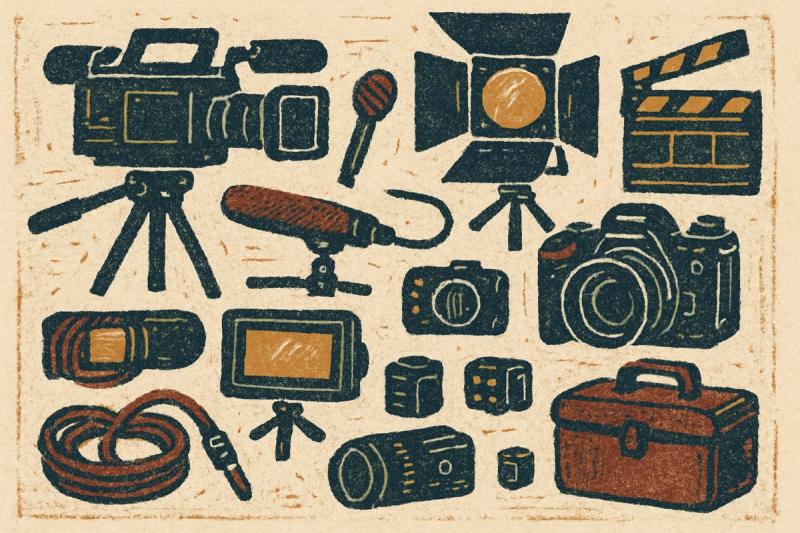 Your budget determines your equipment choices more than anything else in filmmaking. The good news is that decent filmmaking gear exists at every price point from $300 to $30,000. The bad news is that cameras alone won't make you a filmmaker: you need audio equipment, lighting, and support gear too!
Most beginners make a critical mistake. They spend their entire budget on the camera and have nothing left for audio or lighting. A $700 camera with a $30 microphone will produce worse results than a $400 camera with a $300 microphone and basic lighting.
Understanding Your Total Budget #
Calculate your total available budget first. Then split it roughly this way: 40% camera, 30% audio, 20% lighting, and 10% support gear like tripods. This balance creates better results than putting everything into the camera.
For example, a $1,000 budget means approximately $400 for camera, $300 for audio, $200 for lighting, and $100 for support equipment. Adjust these percentages based on what you plan to shoot, but never skip audio equipment entirely.
Below you'll see suggestions; there are many to choose from, but these are decent pieces of equipment worth considering.
Budget Under $500 #
At this level, use your smartphone camera and invest in accessories. Modern iPhones and Android phones shoot excellent 4K video. The Boya BY-M1 lavalier microphone costs about $25 and dramatically improves your audio quality compared to phone microphones.
Add a basic tripod like the AmazonBasics 60-inch for around $25. Spend the remaining budget on a simple LED panel light (Godox SL60 around $130) with a softbox. You can also use natural light with a cheap reflector instead of buying lights initially.
This setup teaches you filmmaking fundamentals without financial risk. Many successful YouTubers started with exactly this equipment combination.
Budget $500-$1,500 #
This range opens up real camera options. The Canon ROS M50 costs around $850 and shoots quality 4K video with decent autofocus. The Sony ZV-E10 at $650 offers excellent color and strong video features.
Pair your camera with the Rode VideoMic GO II (around $100) for on-camera audio. Add a Hollyland Lark Max Duo [Hollyland Lark Max Duo] (approximately $150-200) for interview situations. These wireless systems eliminate cables while maintaining good sound quality.
For lighting, the Amaran 200x LED [Amaran 100x bi-color LED] costs about $280 and provides professional-looking illumination. Add a basic softbox and reflector. A tripod with fluid head runs around $150 and handles smooth camera movements.
This equipment level produces content good enough for most online platforms and low-budget productions.
Budget $1,500-$3,000 #
You enter semi-professional territory here. The Panasonic GH5M2 (around $1,000-1,500) or Blackmagic Pocket Cinema Camera 4K ($1,300) both shoot cinema-quality footage. The Sony A7 IV costs more but offers full-frame quality.
These will all need lenses, however!
Invest in the Zoom H5 audio recorder ($280) and Audio-Technica AT875R shotgun microphone ($180). This combination captures broadcast-quality audio. Add Sony MDR-7506 headphones ($100) for monitoring.
For lighting, purchase two Godox SL 150 III lights ($300 each) with softboxes. This two-light setup handles most interview and narrative situations professionally. A Manfrotto Befree tripod ($200-300) provides reliable camera support.
At this budget level, your technical quality matches what viewers see on television and streaming platforms.
Budget Over $3,000 #
Professional equipment becomes accessible. The Sony FX3 ($3,900), Canon R5 ($3,000), or Panasonic GH7 ($2,000) all deliver cinema-grade imagery. These cameras offer features like 10-bit color, high frame rates, and professional codecs.
For audio, the Sennheiser MKH 416 shotgun microphone ($1,000) represents industry standard quality. Pair it with a Sound Devices recorder or Zoom F6. Sennheiser wireless systems (G4 series, $600+) provide reliable professional audio capture.
Professional LED lights from Aputure (120D II, 300D II) or Rotolight systems offer precise control and durability. Expect to spend $1,000-2,000 per light. Carbon fiber tripods with fluid heads from Sachtler or Manfrotto ($800-2,000) provide the stability professionals demand.
And Then #
But this is the beginning; once you have the gear above you'll find extras need buying. Batteries, boxes, add-ons. So get some contingency money in if you can.
The Honest Truth About Gear #
Better equipment makes filmmaking easier but doesn't guarantee better films.
Technical quality matters less than story, lighting technique, acting, and sound design. A skilled filmmaker creates stunning work with basic equipment. An amateur with expensive gear still produces amateur work.
Start with equipment you can afford today. Learn to maximize what you have before upgrading. Focus especially on audio quality—audiences forgive visual imperfections but abandon content with bad sound immediately.
Consider renting specialized equipment for important projects rather than buying everything. Most cities have camera rental houses where professional cinema cameras cost $100-300 per day instead of thousands to purchase.
Your Next Step #
Make a realistic budget spreadsheet. List exactly what you can spend on each equipment category. Research specific models in your price range and read multiple reviews. Watch comparison videos showing real footage from different cameras.
Remember that filmmaking equipment depreciates quickly. What costs $2,000 today might sell used for $800 in two years. Buy equipment you'll use frequently and rent specialized items you need occasionally.
Start filming with whatever equipment you can afford right now. You'll learn more from making ten short films with basic gear than from researching equipment for six months without shooting anything.


Comments
No comments yet. Be the first to share your thoughts.
Log in to join the discussion.