 enCAST.pro
Will AI kill the film industry? An honest look at where we'll be in 2029
Right now... #
- AI tools are already being used in film production. They speed up specific tasks like de-aging and colour correction. They do not replace people.
- AI cannot yet create believable video of real people. It is nowhere near good enough for professional film or TV.
- If you are a lead or supporting actor, your job is safe. Audiences want real humans on screen.
- If you work as a background performer or voice actor, pay attention. These are the areas feeling the most pressure right now.
- Unions across the US and Europe are fighting hard to protect performers. They are winning real protections.
- Europe's cultural funding rules naturally slow down AI adoption, because most funds require real human creators.
- The biggest risk is not to movie stars. It is to junior crew, background artists, and dubbing actors.
What AI can do right now #
Some AI tools already work well enough for professional productions. They are not experimental. They are being used on real sets today.
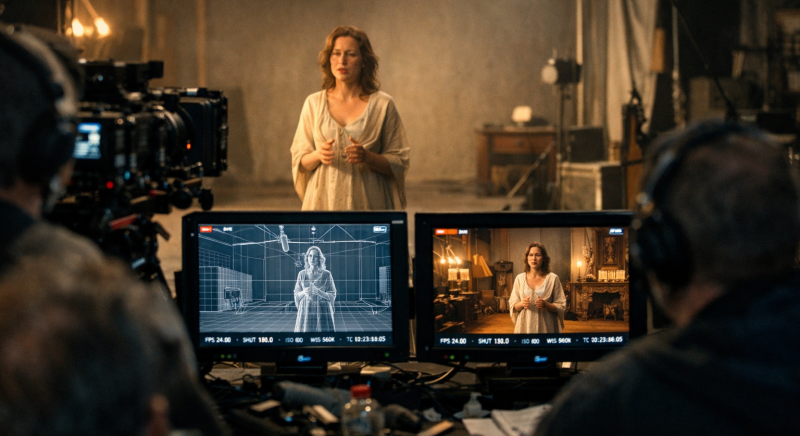
De-aging is one example. The film Here used AI from a company called Metaphysic to make Tom Hanks and Robin Wright look younger. It covered 53 minutes of the film, done in real time on set. The director could see the result on a monitor as they filmed.
Voice refinement is another. The film The Brutalist used AI to polish Adrien Brody's Hungarian pronunciation. Emilia Perez used it to extend a singer's vocal range. Both films received multiple Oscar nominations.
Behind the scenes, AI tools now handle routine work like cutting out backgrounds, matching colours, and reducing noise. Netflix used AI to create a building collapse scene in the Argentine series El Eternauta. They said it was finished ten times faster than traditional methods.
Planning tools also work well. AI can break down scripts, create storyboards, and generate concept art. Productions using these tools report saving around a quarter to a third of their planning time.
These tools make specific tasks faster and cheaper. They do not replace the people doing the creative work.
What AI cannot do #
This is the important part.
AI cannot create believable video of real people. Not yet. Not even close.
The best AI video tool available right now, Runway, produces usable footage about half the time. Each ten-second clip takes five to seven minutes to make. OpenAI's much-hyped Sora tool produces something usable about one time in twenty.
Keeping a character looking the same from one scene to the next? Not solved. Realistic physics? Not solved. Convincing emotional performance? Not solved. Telling a story that makes sense for more than a few seconds? Not solved.
When the well-known director Darren Aronofsky put his name to an AI-made series about the American Revolution, the reaction was overwhelmingly negative. The YouTube trailer got 18,000 thumbs down and only 767 thumbs up. Critics and viewers found it full of visual errors and uncanny-looking characters. The Guardian called it "genuinely very horrible to watch."
A major McKinsey report from January 2026 interviewed over 20 studio executives. They found that AI is currently improving productivity by only 5 to 10 percent on specific tasks. That is useful, but it is not the revolution the tech companies are selling.
Will actors still be needed? #
Yes. But the answer depends on what kind of work you do.
Lead and supporting actors are safe. Audiences connect with real people. They want to see human performances with all their imperfections and surprises. Research across the US, UK, and Germany shows that only about one in five people trust AI content. When people find out something was made by AI, they like it less. This is especially true for anything emotional.
Day players and small roles face moderate risk. These parts still need real human interaction. But some low-budget productions may start using AI for things like digital set extensions to save shooting days.
Background performers and extras should pay attention. AI-generated crowds have been used in films since Gladiator. The technology is getting cheaper and better. For distant and mid-range shots, AI extras are now hard to tell apart from real ones.
Voice actors, especially in dubbing, face serious pressure. AI dubbing can cut costs by 50 to 70 percent. The dubbing market is big and growing fast. But voice actors across Europe are pushing back. German performers are boycotting Netflix AI contracts. French dubbing artists collected over 215,000 signatures against AI voice replacement. Italian dubbers secured the first European AI clause in a national contract.
Unions are fighting back #
This matters a lot.
In the US, SAG-AFTRA has made each new contract stronger on AI. Their 2025 commercials deal says that if a producer uses a digital copy of a performer, they must pay 1.5 times the normal fee. They also have to make benefit contributions for AI-generated performers. The goal is clear: make AI replacement more expensive than hiring a real person.
In the UK, the performers' union Equity held a vote in December 2025. 99.6 percent of members said they would refuse to be digitally scanned on set until they get proper AI protections. If talks with UK producers fail, a formal strike ballot comes next.
Germany agreed Europe's first AI deal for film workers in early 2025. Italy's dubbers won the first European AI clause. Spain is using Italy's deal as a model for their own negotiations.
The EU AI Act becomes fully enforceable in August 2026. It will require all AI-generated content to be labelled. There are also plans to separate "fully AI-generated" content from "AI-assisted" content, which could affect copyright protection.
Europe's built-in protection #
This part is easy to miss, but it matters a great deal for anyone working in European film.
Most European film funds have cultural tests. To qualify for funding, a production usually needs real human creators in key roles: a real writer, a real director, real actors. It needs to use the local language and hire local crew.
These rules exist to protect cultural diversity. But they also work as a natural barrier against replacing people with AI. If a film needs a real French screenwriter to get French funding, it does not matter how good an AI writer becomes.
Italy has gone the furthest. AI production costs cannot be claimed against Italy's tax credit, except for certain special effects involving lead actors. The Deputy Culture Minister said the credit only applies "if you use a real screenwriter, flesh and blood."
Belgium now requires all funding applicants to fill in an AI questionnaire. The BFI in the UK and the Austrian Film Institute have followed this model.
The European Film Agency Directors have also warned that AI systems rely mostly on American content. This could lead to all films starting to look and feel the same. Europe's whole funding system was built to prevent exactly that.
The money side #
The best estimates say AI could reduce production costs by 10 to 30 percent, depending on the type of project. Films with heavy visual effects will see the biggest savings. Dialogue-driven dramas will see the least.
One area where the savings are already real: dubbing and localisation. AI makes it possible to release content in 20 or more languages where previously only 5 to 8 were affordable. For European co-productions trying to reach international audiences, this is a big deal.
The difficult side: a survey of 300 entertainment executives found that three out of four said AI had already led to job cuts or role changes. The people most affected are in junior and entry-level positions in VFX, editing, and post-production.
This is a real problem. If you cannot get your first job as a junior VFX artist because AI does that work, you never get the experience to become a senior one.
What history tells us #
Every big technology change in cinema has caused panic. Sound was going to kill acting. CGI was going to kill practical effects. Digital cameras were going to kill cinematographers. None of that happened. Each change created new roles and actually increased budgets.
But AI is different in one important way. Previous technologies made it easier to capture and edit. AI could make it easier to create from scratch. That is a bigger change.
Even so, the gap between what AI companies promise and what their tools actually deliver is still very wide. Lionsgate announced a major partnership with AI company Runway in 2024. Within a year it ran into problems because the technology was not ready.
What happens next #
By 2028 or 2029, AI will be a normal part of pre-production for most mid-to-large budget films. De-aging, voice refinement, and routine VFX work will be handled partly by AI. AI dubbing will be standard for most language markets. AI-generated crowd scenes and backgrounds will be common.
What will not happen: AI will not make feature films on its own. It will not replace lead actors. It will not allow one person to produce a professional film alone. Creative decisions will still need humans.
For actors in the middle and upper parts of the profession, your work is secure. Audiences want you, unions are protecting you, and the technology is nowhere near replacing you.
For background performers and voice actors, the ground is moving. The protections your unions are fighting for right now will decide how this plays out.
For crew, especially in junior roles, the risk is real and it is happening now. The industry needs to invest in training and new pathways into the profession.
The honest conclusion #
AI is a powerful tool that will become part of every stage of filmmaking within three years. It will not replace the people who make films worth watching. Europe's mix of cultural protections, union agreements, and new regulations may turn out to be an advantage, giving European producers access to tested, reliable tools rather than experimental ones.
The people most at risk are not the ones in the headlines. They are junior VFX artists, background performers, and dubbing actors whose working lives are changing right now. That is where the attention needs to be.
published March 2026


Questions about this page?
If something here is unclear or out of date, let us know through our contact page.